-
Connexion
- Inscription
- 2 222 906 inscrits »
quelquun - Mise à jour : 08/03/2009
112 téléchargement(s)
format .doc
29 Ko
Niveau : Bac+4
Extrait / Introduction
Cours d'anglais, niveau Bac+4; sur la pauvreté en économie - Absolute and relative poverty (economics)
Extrait:
In general, everybody agrees that poverty indicates a shortage of some sort. Although, not all shortages can be equated with poverty. In the 18th century, poverty was considered inevitable and even a necessary fact of life. Thomas Malthus[1] (1766-1834) considered that it was natural to control the growth of the population be it by starvation[2], because if help was given to the poor[3], they would have more children and they would beget[4] too many mouths to feed. Population, he said, increases in a geometrical ratio whereas subsistence increases in an arithmetical ratio. [...]
Intro:
In general, everybody agrees that poverty indicates a shortage of some sort. Although, not all shortages can be equated with poverty. In the 18th century, poverty was considered inevitable and even a necessary fact of life. Thomas Malthus[1] (1766-1834) considered that it was natural to control the growth of the population be it by starvation[2], because if help was given to the poor[3], they would have more children and they would beget[4] too many mouths to feed. Population, he said, increases in a geometrical ratio whereas subsistence increases in an arithmetical ratio.
More recently, poverty has been seen not as a fatality but as something that should be eliminated. Something should be done about it anyway[...]
Plan:
Plan
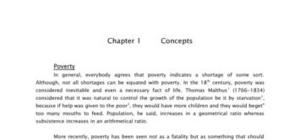
Exemple de page de Absolute and relative poverty (economics)
Chapter 1 Concepts
Poverty
In general, everybody agrees that poverty indicates a shortage of some sort. Although, not all shortages can be equated with poverty. In the 18th century, poverty was considered inevitable and even a necessary fact of life. Thomas Malthus1 (1766-1834) considered that it was natural to control the growth of the population be it by starvation2, because if help was given to the poor3, they would have more children and they would beget4 too many mouths to feed. Population, he said, increases in a geometrical ratio whereas subsistence increases in an arithmetical ratio.
More recently, poverty has been seen not as a fatality but as something that should be eliminated. Something should be done about it anyway, because poverty causes suffering but also because it takes away the forces which will build the future. In fact, there is not one single definition of poverty. It is a negative concept which raises the question of what should be done. In fact, it is almost a moral concept: the suffering caused by poverty is unacceptable; therefore action must be taken to alleviate it. Basically, the definitions of poverty are classified according to whether they are absolute or relative.
Absolute poverty
Absolute poverty describes a situation where the absolute necessities of survival (food, clothing, warmth and shelter) are lacking. This is a narrow definition which doesn’t take into account social, emotional or intellectual needs (Maslow). In the 1950’s, absolute poverty was defined as the condition of those who couldn’t afford5 ?the minimum provision needed to maintain health and working efficiency?. A family budget was estimated, based on the cost of the cheapest food and cloth which would meet the basic needs. Absolute poverty is above all characterized by hunger insalubrious housing and inadequate clothing. Such conditions were common at the beginning of the 20th century, but rarer today and even almost inexistent in Britain. At any rate6, absolute poverty is based on the notion that all individuals share the same physical needs for survival.
Pour visualiser la suite du document Absolute and relative poverty (economics) vous pouvez :
Le document Absolute and relative poverty (economics) appartient à la rubrique Anglais qui elle même appartient à la thématique Langue.
Ils ont téléchargé aussi
Nouveaux documents Anglais